
We first performed Ailsa Dixon’s chamber music with her set of songs The Spirit of Love, written for Soprano and String Quartet. When we gave the world premiere with the soprano Lucy Cox at St. Geroge’s Hall Bristol in late February 2020, little did we know this would be one of the last concerts we would perform, before the world ground to a halt due to Covid-19.
Fast forward more than two years later, we find ourselves in a different world. Much of it is familiar, and we are caught up once again in the fast-paced life of musicians traveling and performing live. It is odd to think that in a different age, this activity would have been classed as illegal. However, as the flurry of daily life returns with a vengeance, we also know things have changed permanently. In my own orbit, I am quietly recalibrating this change, especially after seeing the excesses of our daily lives before the pandemic.
So it is fitting that in the Villiers Quartet, we are able to return to Ailsa Dixon’s music more than two years later, this time with her work Variations on Love Divine. Although the pandemic is far from over, we could use her compositions as ‘bookends’ for this period in our history. For us, her music marks a time when we were fearful about the future, to a time when we have more knowledge about how the future can play out.
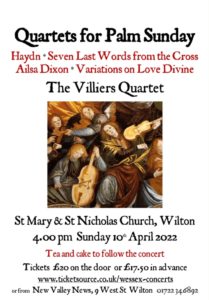
We are privileged to be giving the concert premiere of Ailsa Dixon’s complete Variations on Palm Sunday, 10th April. We are pairing this work with Haydn’s The Seven Last Words of Christ, the eponymous work for string quartets during Easter Week. Dixon’s concept for the Variations references many moments of Haydn’s work. Rather than writing a large mass or requiem, both Haydn and Dixon use the intimacy of string quartet to construct a musical meditation on religious events. I often view these works as if they were a composed “Stations of the Cross” where pilgrims can walk quietly through the church and meditate on different parts of the Christian story.
Ailsa Dixon’s Variations begin with the first line “In the beginning was the Word, and the Word was with God.” Over a series of 19 variations, she depicts the birth, life, and death of Jesus in short musical scenes. Dixon does not spare any note as she takes the drama right down to its core elements. There is no room for excessive or lengthy writing in this quartet – instead, she insists that the listener focus on the stillness and presence of the music. If you blink, you’ll miss the point. With this work, she is able to depict an entire life story through a series of pointed miniatures.
It takes a great deal of empathy and understanding, to discover the mindset of the composer as they write a piece. For both Haydn and Dixon, they have created intimate works which challenge the listener to remove the baggage of daily life at the door, and enter the world of quietness and stillness. And in listening, perhaps we find the time to recalibrate our own lives.
-Carmen
Purchase tickets to hear Dixon’s Variations on Love Divine here.

0 Comments